We Won Best Tech at Demo Night. Here Is What the Judges Saw.
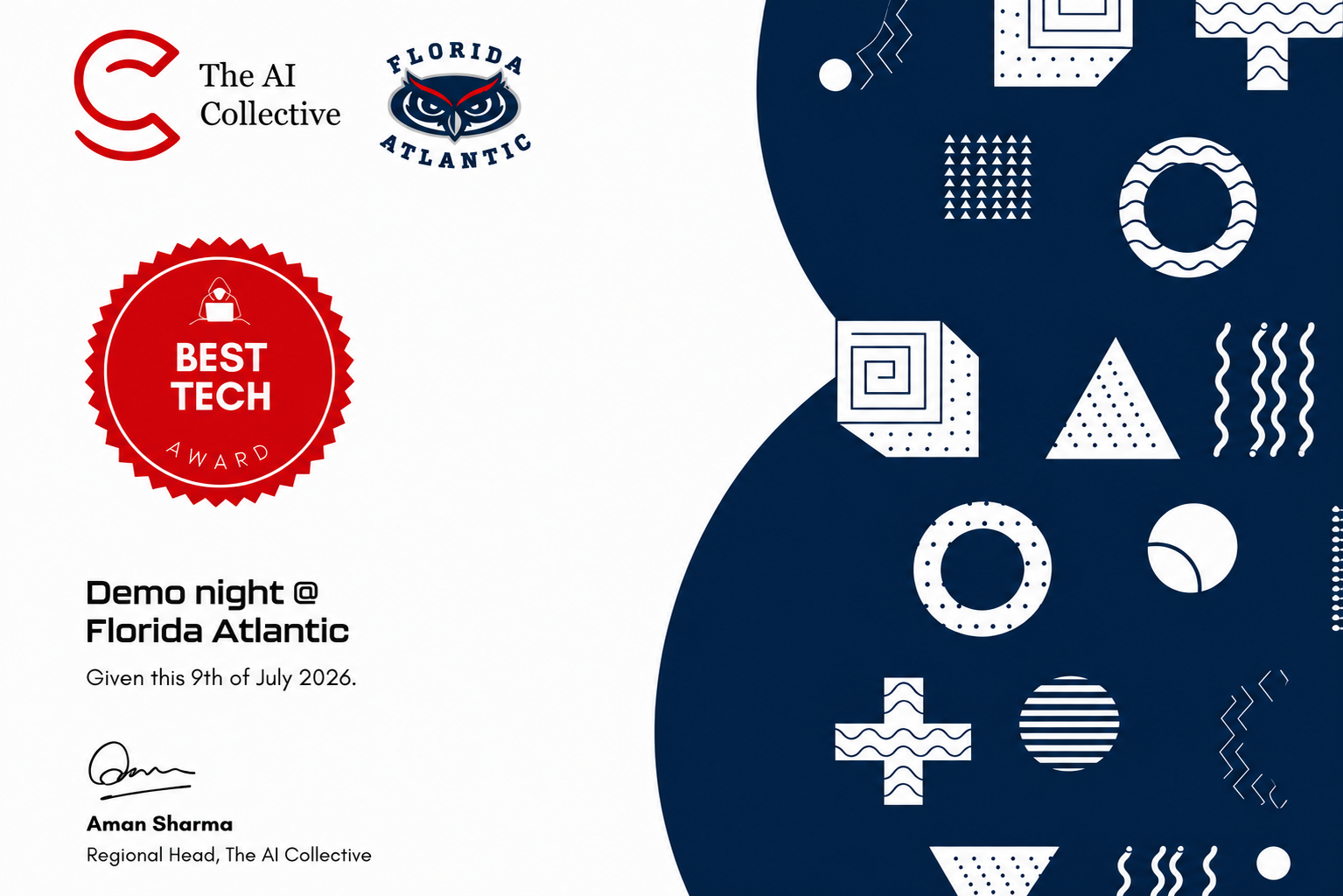
Presented by Aman Sharma, Regional Head, The AI Collective
This week Nyquest took home Best Tech at the Demo Night hosted by Florida Atlantic University and The AI Collective. We had four minutes on stage — so we showed the three things that make Nyquest different, live: the Splicer, our compression engine, and the AutoRouter.
The Splicer: consensus from four frontier models
Ask one question; get the judgment of several models. The Splicer fans a single prompt out to four flagship models from four different vendors — Grok, Claude, Gemini, and GPT — in parallel, then a consensus judge reconciles their answers, scores how much they agree, and surfaces where they diverge. On stage it returned a consensus answer in under four seconds.
The engineering that matters is graceful degradation: the orchestrator waits for a quorum of answers, then gives any stragglers a bounded grace window before it judges — so one slow or rate-limited model can never stall the whole run. Each lane rides its vendor’s own API first, with a shared gateway as fallback. Consensus, with receipts, fast enough to feel instant.
Compression: a smaller prompt before it ships
Every prompt that goes through Nyquest runs through our own compression engine first. It trims redundant tokens before the request ever reaches a model, without changing what you actually asked. Fewer tokens in means lower cost per request — and because the savings compound with volume, our economics get better as we scale, not worse. It is the quiet layer that makes everything else affordable.
The AutoRouter: the right model, automatically
There are hundreds of models available through Nyquest, and nobody should have to keep a mental spreadsheet of which one to use. The AutoRouter reads each request and sends it to the right model for the job — a fast, inexpensive tier for simple asks, a frontier model for the hard ones — automatically. You bring the work; it handles the routing. When two options are equally capable, the cheaper one wins.
Consensus, compression, routing — those three carried the four minutes. Beyond them, the same workspace also turns a prompt into images, voice, music, and video, and can ground answers in live web results with citations. But on stage, we led with the tech that makes Nyquest Nyquest.
An honest note
Engineering blogs should be honest, so: the days before Demo Night were spent hardening, not coasting — tightening the Splicer so slow models stop getting dropped, and fixing the small things you only find by using your own product hard. None of what we showed is a mockup or a roadmap slide. It is shipped, live, and running in production today — with 96 automated end-to-end checks against production every day. That, more than anything, is what the award means to us: the tech works, on stage and every day after.
- Splicer — one prompt, four frontier models in parallel, a scored consensus in under 4 seconds
- Compression — our own engine trims tokens on every request, so cost drops as we scale
- AutoRouter — every request routed to the right model automatically; cheapest-equivalent wins
- All shipped and live — 96 automated production checks, run daily
Try the award-winning workspace → No account needed to start — or bring your own API key.